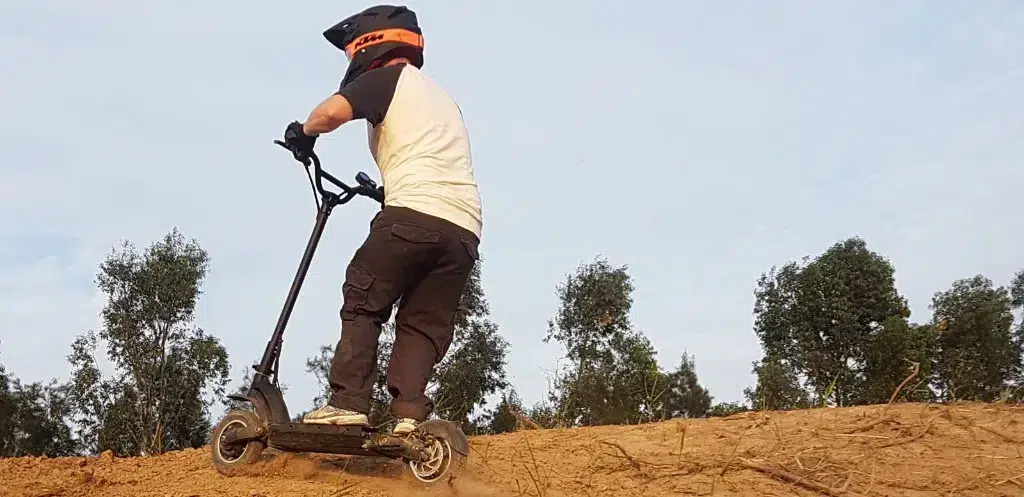






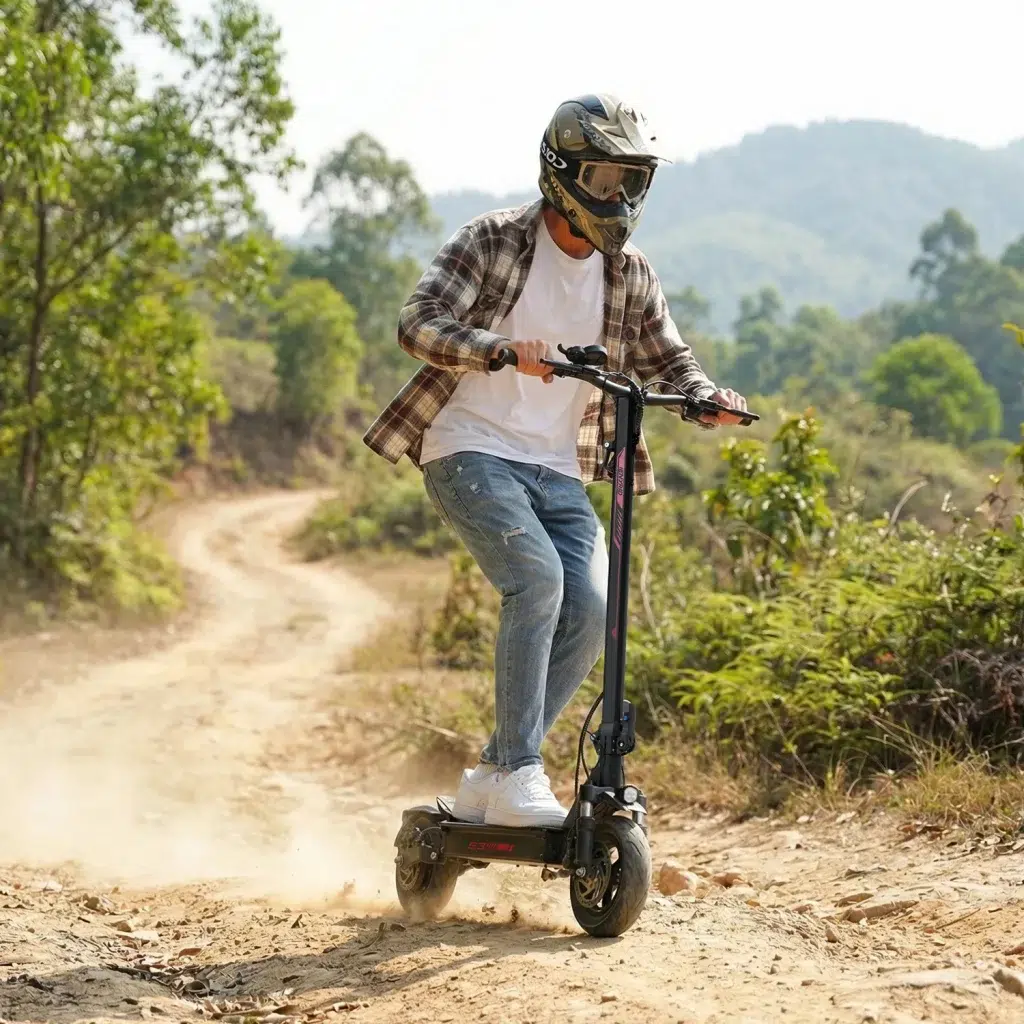
The best off-road electric scooters of 2026 combine large pneumatic tyres (10–11 inch), front and rear suspension, disc brakes, a minimum 48V battery and dual or high-torque single motors. Matching the right model to your terrain, rider weight and storage situation matters more than chasing the highest top speed. For private-land use only under current UK law.
Gravel tracks, rough private ground, loose dirt and uneven surfaces demand a very different scooter to a folding commuter model. Thin solid tyres, single-spring suspension and entry-level brakes handle smooth tarmac well enough – but on the kind of terrain this guide covers, they transmit every bump into the rider, lose grip on loose surfaces and take noticeably longer to stop.
Off-road electric scooters address this with larger pneumatic tyres for absorption and traction, front-and-rear suspension to keep both wheels planted, dual disc or hydraulic brakes for consistent stopping power, and frames strong enough to absorb repeated impacts without flexing.
How We Selected These Scooters
All recommendations are drawn from Rapid Scooter Master’s live UK stock at time of publication. Models listed as sold out on rapidscooter.co.uk have been excluded.
Selection factors: live availability, motor configuration and nominal/peak power, battery voltage and capacity, manufacturer’s claimed range, any documented Rapid Scooter Master real-world range, suspension type, tyre size and construction, brake type, weight, maximum payload, IP rating, and suitability for uneven private ground.
Selected using verified specifications and Rapid Scooter Master’s sales and service experience.
Current Top Picks by Use Case
KuKirin G2 Ultra – Best Entry-Level Dual Motor Off-Roader
A newly launched 2026 model and the most accessible dual-motor option in the current range. The reinforced dual-stem frame is a genuine structural upgrade over standard single-stem builds, improving steering precision at speed and reducing flex over rough ground.
Best for: Riders stepping up from a single-motor scooter who want proper dual-motor traction and off-road tyres without the weight of larger performance models.
Not ideal for: Longer expeditions – the tested range is shorter than larger-battery alternatives.
Spec | Detail |
Motor | Dual 800W (1,600W nominal) |
Battery | 48V 18Ah |
Mfr. claimed range | Up to 34 miles |
Rapid documented range | Up to 25 miles |
Top speed | 31 mph |
Tyres | 10″ off-road vacuum (tubeless) |
Suspension | Front & rear cantilever spring |
Brakes | Front & rear disc |
IP rating | IPX4 |
Weight | 34 kg |
Max load | 120 kg |
Limitations: 9–10 hour charge time; IPX4 is splash-resistant, not waterproof; 34 kg requires two people to lift into most vehicles.
Source: rapidscooter.co.uk/product/kukirin-g2-ultra – checked August 2026.
—
iENYRID ES1 – Best Value Dual Motor Pick
A strong power-to-price proposition. Dual 2,400W motors put the ES1 among the most powerful models under £700 in the current range, and the 48V 20.8Ah battery gives a credible claimed range for mixed-surface riding.
Best for: Riders who want serious dual-motor grunt and a 10″ off-road tyre setup at a competitive price point.
Not ideal for: Riders prioritising the lightest possible carry weight, or those needing a very wide deck for stability.
Spec | Detail |
Motor | Dual 2,400W |
Battery | 48V 20.8Ah |
Claimed range | 37 miles |
Top speed | 37 mph |
Tyres | 10″ off-road pneumatic |
Suspension | Front & rear |
Brakes | Front & rear disc |
IP rating | IPX4 |
Weight | 30 kg |
Max load | 120 kg |
Limitations: Charge time approximately 8 hours; IPX4 – do not ride in heavy rain.
Source: rapidscooter.co.uk/product/ienyrid-es1-e-scooter – checked August 2026.
—
VIPCOO VS6 Pro – Best Mid-Range Value Off-Roader
The VS6 Pro packages a four-arm suspension system and dual mechanical disc brakes with electronic braking backup into a 31 kg chassis – lighter than many dual-motor rivals at this power level. The 52V battery is a voltage step up from the ES1, which translates into slightly more consistent power delivery across a charge cycle.
Best for: Riders who want a lighter dual-motor scooter with a well-rounded suspension setup and a free accessories bundle (cable lock and storage bag included at time of publication).
Not ideal for: Riders needing hydraulic brakes or a maximum load above 120 kg.
Spec | Detail |
Motor | Dual 2,400W |
Battery | 52V 20.8Ah |
Claimed range | 40 miles |
Top speed | 37 mph |
Tyres | 10″ off-road pneumatic |
Suspension | Front & rear four-arm system |
Brakes | Front & rear disc (mechanical + electronic) |
IP rating | IPX4 |
Weight | 31 kg |
Max load | 120 kg |
Limitations: Charge time approximately 9–10 hours.
Source: rapidscooter.co.uk/product/vipcoo-vs6-pro-electric-scooter – checked August 2026.
—
KuKirin G2 Master – Best All-Terrain All-Rounder
The G2 Master is the most capable all-round off-road scooter in the current live range. A 30-degree maximum climb rating – confirmed by the manufacturer – is among the highest of any in-stock model. Tubeless 10″ tyres reduce puncture risk on rough ground, and IP54 provides better dust and splash protection than IPX4-rated alternatives. The dual-charging option cuts recharge time from approximately 11 hours down to around 7.
Best for: Riders who want a capable, proven dual-motor platform for varied private terrain – from packed gravel to loose hillside paths.
Not ideal for: Riders sensitive to weight; at approximately 33.1 kg (manufacturer specification), this is a two-person lift for vehicle loading.
Spec | Detail |
Motor | Dual 1,000W (2,000W nominal) |
Battery | 52V 20.8Ah |
Claimed range | 44 miles |
Top speed | 38 mph |
Tyres | 10″ off-road tubeless |
Suspension | Front & rear |
Brakes | Dual disc |
IP rating | IP54 |
Weight | ~33.1 kg (mfr. spec) |
Max load | 120 kg |
Max climb | 30 degrees |
Limitations: Standard charge approximately 11 hours; fast charge approximately 7 hours with compatible charger.
Source: rapidscooter.co.uk/product/kukirin-g2-master-electric-scooter; kukirin-scooter.com – checked August 2026.
—
KuKirin G4 – Best Single-Motor Long-Range Option
The G4 takes a different approach to most rivals here: one highly tuned 2,000W rear-hub motor instead of a dual setup. The result is a scooter with a higher top speed than the G2 Master (43 mph), the largest manufacturer-claimed range of any single-charge in-stock model, and 11″ tubeless tyres for better obstacle clearance. Its integrated cooling system is designed to sustain motor output on long or steep runs without overheating.
Best for: Experienced riders who prioritise raw top speed and long-range battery over dual-motor traction; riders covering extended private tracks.
Not ideal for: Loose surfaces where dual-motor traction makes the bigger difference; riders needing a 150 kg payload.
Spec | Detail |
Motor | Single 2,000W rear hub |
Battery | 60V 20Ah |
Claimed range | 46 miles |
Top speed | 43 mph |
Tyres | 11″ tubeless |
Suspension | Front & rear shock absorbers |
Brakes | Front & rear disc |
IP rating | IPX4 |
Weight | 37 kg |
Max load | 120 kg |
Max climb | 20-degree incline |
Limitations: Charge time approximately 12 hours – plan overnight charging; single-motor configuration gives less traction redundancy on very loose surfaces than dual-motor rivals.
Source: rapidscooter.co.uk/product/kukirin-g4-electric-scooter – checked August 2026.
—
VIPCOO VS9 – Best for Heavier Riders and Maximum Performance
The VS9 is the most powerful in-stock model in the current range. Dual 1,800W motors (3,600W combined) pair with hydraulic disc brakes – a meaningful upgrade over mechanical disc setups at this speed – and an extra-wide 22 cm deck that gives larger riders a stable platform. With a 150 kg maximum payload, it also accommodates riders whom several other models cannot. Rapid Scooter Master’s documented real-world range of approximately 33 miles is more conservative than the manufacturer’s 56-mile claim, which is worth factoring into route planning.
Best for: Heavier riders, those wanting hydraulic braking at higher speeds, or experienced riders covering demanding private terrain.
Not ideal for: Anyone who needs to carry the scooter regularly – at 45 kg, loading it without vehicle-level access or assistance is impractical.
Spec | Detail |
Motor | Dual 1,800W (3,600W nominal) |
Battery | 60V 26Ah |
Mfr. claimed range | 56 miles |
Rapid documented range | Up to 33 miles |
Top speed | 40 mph |
Tyres | 11″ off-road pneumatic |
Suspension | Dual-spring front & rear |
Brakes | Front & rear hydraulic disc |
IP rating | IP54 |
Weight | 45 kg |
Max load | 150 kg |
Deck width | 22 cm |
Limitations: Charge time 6–8 hours; real-world range is significantly below the manufacturer’s claimed figure.
How to Choose the Right Off-Road Electric Scooter
Does Motor Configuration Make a Difference on Loose Ground?
Dual-motor scooters drive both wheels, which improves traction on loose gravel, muddy paths and steep inclines – especially when one tyre loses grip. A single high-torque motor like the G4’s 2,000W rear-hub unit delivers strong performance on hard surfaces and moderate trails, but a dual setup is generally better suited to genuinely loose or slippery terrain.
Higher nominal wattage does not automatically mean better off-road performance. Torque delivery, suspension calibration and tyre choice interact significantly. Treat wattage as one signal, not the whole story.
How Should You Think About Battery Capacity and Real-World Range?
Manufacturer range figures assume optimal conditions: a light rider, low speed, smooth surface, mild temperature and full tyre pressure. Off-road riding – particularly on hills, loose ground, or in cold weather – can reduce your actual range by 25–40% compared to the claimed figure. Build in a reserve. If a route requires 20 miles, a scooter with a 25-mile real-world range in good conditions is cutting it close.
Battery capacity in watt-hours (Wh) is calculated by multiplying voltage by amp-hours. The VS9’s 60V × 26Ah = 1,560Wh gives it the largest energy reserve in the current range, which partly explains its stronger claimed range despite the high power draw of dual 1,800W motors.
What Should You Look for in Suspension, Tyres and Brakes?
Tyres: Pneumatic (air-filled) tyres absorb ground impacts before they reach the rider and give better traction on loose surfaces. Tubeless construction reduces puncture risk. All six models here use pneumatic tyres. 11-inch tyres (G4, VS9) offer slightly better obstacle clearance than 10-inch alternatives.
Suspension: Dual spring or cantilever setups at both ends keep both wheels in contact with uneven ground. The VS9’s dual-spring hydraulic combination offers the most sophisticated setup in the current range; the G2 Ultra’s cantilever spring system is a thoughtful design choice at its price tier.
Brakes: Hydraulic disc brakes (VS9) provide more consistent stopping power across temperature changes and repeated use than mechanical disc systems. At speeds above 35 mph on rough ground, the difference is meaningful. All models here use disc brakes as a minimum.
IP ratings: IPX4 protects against splashes from any direction. IP54 adds basic dust resistance. Neither rating means the scooter is waterproof – do not ride any model in heavy rain or through standing water.
Weight Versus Battery – Understanding the Trade-Off
Larger batteries and more powerful motors add weight. The lightest model here (iENYRID ES1 at 30 kg) is also one of the lowest-capacity. The heaviest (VS9 at 45 kg) carries the largest battery. If you need to load the scooter into a vehicle boot regularly, that 15 kg difference matters considerably. Only the lighter end of this range – the ES1, VS6 Pro and G2 Master – can be lifted solo by most adults, and even then, the process is awkward.
Electric Scooter vs Electric Bike Off-Road
An off-road e-bike typically runs 24–29-inch wheels, a lower saddle-based riding position, a more upright weight distribution and geared or torque-sensor motor assistance rather than direct throttle control. Those design choices make e-bikes better suited to technical trail riding, longer distances and routes where you’d otherwise push up hills.
Off-road scooters are lighter to transport (generally), simpler mechanically, and give a different riding experience – standing rather than seated, with more direct surface feedback. They are a better fit for private land exploration, shorter routes and riders who prefer not to pedal.
Under current UK law, both privately owned e-scooters and pedal-assist e-bikes (those meeting EAPC regulations) have distinct rules. If your route includes any public road section, an EAPC-compliant e-bike is the only legal motor-assisted option.
Which Option Is Best for You?
- Entry-level dual motor / first off-roader: KuKirin G2 Ultra – accessible spec, 2026 platform, 25-mile real-world range. Limitation: shorter tested range than mid-tier rivals.
- Best value dual motor: iENYRID ES1 – most power per pound in the current range. Limitation: mechanically basic suspension versus the VS9.
- Mid-range all-rounder: VIPCOO VS6 Pro or KuKirin G2 Master – the G2 Master edges ahead on IP rating, climb angle and tubeless tyres; the VS6 Pro wins on weight. Limitation: neither has hydraulic brakes.
- Long-range single motor: KuKirin G4 – highest top speed, strong range, 11″ tyres. Limitation: single-motor traction on loose surfaces; 12-hour charge time.
- Heavier riders or maximum performance: VIPCOO VS9 – 150 kg payload, hydraulic brakes, IP54. Limitation: 45 kg chassis; real-world range considerably below the claimed figure.
Real-World Expectations
Off-road riding drains batteries faster than urban use. Expect to lose 25–40% of the manufacturer’s stated range depending on terrain gradient, surface type, rider weight, outside temperature and tyre pressure. Keep tyres at the recommended pressure – under-inflated tyres absorb more power and increase puncture risk.
Before any ride, check: stem fold is secure and locked; both brakes engage firmly before building speed; tyre pressure is within spec; headlight and rear light function. On private land, always inform someone of your planned route and duration.
Safety kit for off-road riding should include, at minimum, a full-face or open-face helmet, gloves and appropriate footwear. At the speeds these scooters reach, protective eyewear and knee/elbow guards are strongly recommended.
Find the Right Scooter at Rapid Scooter Master
Every model in this guide is stocked and supported at Rapid Scooter Master’s two London stores – Kilburn (2 Oxford Road, NW6 5SL) and Finchley (671 Finchley Road, NW2 2JP) – and available for next-day UK delivery where in stock. Rapid Scooter Master is an authorised UK retailer for KuKirin, VIPCOO and iENYRID, with in-house repair and servicing available at both branches.
If you’re unsure which model fits your terrain, rider weight and storage situation, speak to the team directly: call 020 7072 2847 or use the live chat on rapidscooter.co.uk.
Browse all electric scooters | Dual motor range | Repairs and servicing
Frequently Asked Questions
What makes an electric scooter suitable for off-road use?
Off-road electric scooters use large pneumatic tyres (typically 10–11 inches) to absorb ground impacts and maintain traction on loose surfaces. Front and rear suspension keeps both wheels planted over uneven ground. Disc or hydraulic brakes provide reliable stopping power at higher speeds. Dust and splash resistance (IP54 or IPX4) protects internal components. A high-capacity battery compensates for the faster energy draw of rough terrain. Lighter, rigid commuter scooters lack these features and are not built for repeated off-road use.
Can I ride an off-road electric scooter on UK roads?
No. Under current UK law (GOV.UK, 2025), it is illegal to ride a privately owned electric scooter on any public road, pavement, cycle lane or park. Privately owned e-scooters may only be ridden on private land with the landowner’s permission. Breaking this law can result in a fine, penalty points on your licence and seizure of the scooter.
How much does real-world range differ from the manufacturer’s claimed range?
Significantly. Off-road conditions, rider weight, hills, speed, temperature and tyre pressure all reduce the usable range below the manufacturer’s figure. As a general guide, plan for 25–40% less than the claimed range when riding on rough terrain. Rapid Scooter Master documents real-world range separately for some models – the VIPCOO VS9, for example, carries a manufacturer claim of 56 miles but a Rapid-documented real-world range of approximately 33 miles.
Is dual motor better than single motor for off-road riding?
On loose or slippery surfaces, dual-motor scooters – which drive both wheels – generally provide better traction than single-motor alternatives. The advantage is most noticeable on steep inclines, mud and gravel. A high-torque single motor such as the KuKirin G4’s 2,000W rear-hub unit performs strongly on firm off-road surfaces and carries the benefit of a simpler drivetrain. Choose dual motor if your terrain is loose or hilly; consider single motor if range and top speed matter more and the surface is reasonably firm.
How heavy are off-road electric scooters, and does it matter?
The in-stock off-road models at Rapid Scooter Master range from approximately 30 kg (iENYRID ES1) to 45 kg (VIPCOO VS9). Most adults can manage up to around 33 kg with difficulty; anything heavier typically requires two people to lift into a vehicle. If you need to transport the scooter regularly, weight should be a primary selection factor, not an afterthought.
What IP rating is appropriate for off-road use?
IPX4 means the scooter is protected against splashes from any direction – adequate for light mud and damp ground. IP54 adds basic dust resistance, which is more appropriate for dry loose-surface riding. Neither rating means the scooter is waterproof. Do not rid e any model in heavy rain, through puddles or in standing water, regardless of its IP rating.